
Dr. Avraham Cohen’s Field Notes #82
March 1, 2026
Avraham Cohen, PhD, RCC-ACS, CCC
dr.avrahamcohen@gmail.com
The guest author this month is Neelam Olk, MC, RCC (see bio and contact information at the bottom of the page)
The Power of
Human
Connection

Quotes:
“Perhaps the secret of living well is not in having all the answers but in pursuing unanswerable questions in good company.”
—Rachel Naomi Remen
“We cannot live only for ourselves. A thousand fibers connect us.”
—Herman Melville
Audio Version:
The Power of Human Connection
by Neelam Olk, MC, RCC
It’s not news to hear that connection and relationships matter deeply. And yet, despite knowing this, we often look beyond that wisdom, and deem other pursuits like wealth, fame, and achievements more valuable. We convince ourselves that success and joy are rooted in material gain. If only we had more money, a bigger house, a better car, a prestigious career, or a better body, then we would feel more fulfilled. As Alain de Botton suggests, we’re not very skilled at identifying what truly makes us happy, mistaking status and external success for the deeper relational foundations of wellbeing (Status Anxiety, 2004).
Many longevity experts on social media emphasize that moving our bodies and eating well are the keys to a longer, happier life. Sleep, movement, nutrition, protein, and recently creatine have become the pillars of online health culture. Yet the positive impact of social relationships on health is rarely part of the conversation. There is little emphasis on the value of social connections and overall wellbeing. If anything, we’re encouraged to optimize our routines in ways that prevent us from spending time with our loved ones.
I’ve always loved learning about health. Years ago, I would watch documentaries to better understand how to care for my body. I didn’t have the same access to knowledge we now carry in our pockets, but that didn’t stop me from discovering workout routines, supplements, and the value of nutrition paired with good sleep. There was something meaningful about seeking out documentaries created by people who are passionate about health. It felt deliberate. It felt intentional.
Now, we have an abundance of information and choices that can feel overwhelming, even paralyzing. Our algorithms are quietly tracking what captures our attention, and if we linger on a post for too long, we’re fed the same content for days. The search is no longer deliberate. Intention has left the building.
As Rachel Naomi Remen writes “perhaps the secret of living well is not in having all the answers but in pursuing unanswerable questions in good company.”
The next time a question arises, consider asking a friend, a therapist, a teacher, or a colleague before turning to the internet. You never know, you might spark up a conversation that surprises you. You might discover that the real value lies within the conversation itself and the connection it creates.
Robert Waldinger, director of the longest running study of adult development and happiness, The Harvard study of Adult Development beginning in 1938, reports that “social connections are good for us; loneliness kills.” People who are more socially connected are happier, physically healthier and live longer. Those who are more isolated are less happy, experience earlier cognitive decline, and face more health problems.
He also notes “good relationships don’t just protect our bodies; they protect our brains.” Importantly, the quality of these relationships matter. We can feel lonely in a marriage, in a crowd, and especially, in relationships that mainly exist on screens.
Most of us know that our relationships matter. We feel it after an evening with people we love. So why do we continue to prioritize other forms of growth (career, popularity, money, etc.) in the pursuit of success? Waldinger suggests it’s because we’re drawn to quick fixes. And it’s hard to fault us. In the modern, western world, the definition of a “successful” life can feel confusing and fragmented for many reasons.
- We’re being conditioned to believe we’re not enough.
As a millennial I grew up watching shows like The Fresh Prince of Bel-Air and 7th Heaven. Not only did their lives seem perfect and polished, but they also talked about their problems, provided emotional support, and modelled healthy repair after conflict.
As a brown skinned girl, I rarely saw anyone who looked like me on screen. And at home, my family didn’t always share the same capacity for emotional expression, regulation, and communication. There was a powerful gap between what I watched and what I lived.
As humans, we naturally compare ourselves to others. When we perceive ourselves as falling short, feelings of inadequacy and shame can quietly arise. We consume media for entertainment, but without perspective, it can distort our expectations of what relationships–and life–should look like. Real life and relationships are messier than what’s curated for us.
When shame lingers and we don’t know how to process it, we may reach for quick relief. Material successes, productivity, and consumption can offer quick dopamine hits. These are temporary distractions from the deeper discomfort of a self-limiting belief and feeling of not enough.
- We’re conditioned to consume from a young age.
It begins innocently with toys, Pokémon cards, clothes, etc. Value becomes associated with what we have. I’ve even noticed in my daughter’s grade 1 class that lunch boxes are quietly compared and evaluated. Who was lucky enough to bring pasta in a thermos? Who had the plain cream cheese sandwich in a brown paper bag? Even at 6 years old we begin learning that what we have says something about our worth.
- We’re sold an image of happiness.
Commercials, social media posts, and movies often equate happiness with wealth – tropical vacations, luxury items, and beautiful homes. The message is loud and persistent; if you build a life that looks like this, you will feel like this.
Our Ego is an aspect of the mind that helps us function well in society through navigating identity, status, and belonging. It is the part of us that absorbs these messages and constructs fantasies and automatic thoughts based on what it has repeatedly seen, not necessarily on what is true.
Without reflection, these narratives can shape our goals and worth. This is where self-awareness becomes necessary. We must gently question our automatic thoughts and examine the stories we’ve internalized. Our ego is meant to protect us, but it needs guidance.
- We’re given simplified relationship advice.
Therapists and mental health influences on social media often encourage us to maintain strong boundaries with loved ones. We’re repeatedly told that “no” is a complete sentence, to prioritize our own individual well-being, to declutter our schedules, and to spend time with people who align with our values.
This advice sounds empowering at first. But relationships are inherently complex, messy, and require repair. They bring discomfort alongside connection. When pain arises, it could be interpreted as misalignment rather than an invitation for growth.
Social media posts rarely allow space for nuance, and complicated relational dynamics are explored in two-minute videos. Does it help to have relationships with people who have similar values? Yes. Can we maintain meaningful relationships with people who have different values? Also, yes. However, honoring our differences requires communication, humility, time and relational work.
- Hard work is a priority.
Work-life balance is a popular subject. Michelle Obama recently mentioned on a podcast that trying to balance all our roles seamlessly “doesn’t exist.” I quite like this idea. As a therapist, I feel grateful for how much I enjoy my work and learning about psychology, the inner and relational world, and the cosmos. It feels fulfilling, but I need to be honest with myself about the drawbacks of working too much, including time away from the people who matter most. Maintaining a great marriage is one of the hardest things, and I would argue that it is much harder than a thriving career. And yet, many of us spend most of our time working on our careers, and very little time learning about relationships.
So, what can we do about this?
This list can feel daunting, but a (much needed) silver lining is that we can really work through these challenges. Some useful tools include
- re-programming: we, in fact, are good enough, regardless of materialism.
- mindfulness: our brains register how fulfilling it is to connect with loved ones.
- inner + relational work: we need this work to show up better in our messy relationships).
- work/life balance. As a mom of two young children, I’m still figuring this one out.
According to John Gottman’s research, the main ingredient of thriving relationships is “turning towards our partners bids for connection.” Gottman found that “master” couples turned towards their partners 86% of the time, whereas less happy couples only turned towards their partners 33% of the time (Ury, 2019.
Bids for connection are unremarkable moments between couples like an exacerbated sigh, a comment about a bird outside the kitchen window, or an offer to share food. “Bids” don’t always appear to be attempts to connect emotionally, but they are. If we’re not paying attention, then these attempts to connect can be missed. Even worse, we can reject the bid: e.g., “I’m trying to watch the hockey game!”
I like to share Gottman’s findings with couples I see in my practice, especially when I feel that a partner is struggling with loneliness. Turning towards our partners when prompted seems like an obvious and easy way to connect. However, I’m concerned about how distracted we are in the modern world. It’s quite tempting to turn towards our devices. What used to be moments of boredom, space, and introspection are now moments of scrolling, online shopping, and more mindlessness.
It’s not our fault. These devices are meant to be seductive and addictive. It’s hard to resist these tiny machines engineered with our interests, likes, dislikes, and vast amount of knowledge about everything and anything. I once spent a week tracking a potential hurricane in Florida (despite living in British Columbia), and couldn’t believe how little I knew about storms. Suffice to say, rabbit holes on the internet are endless.
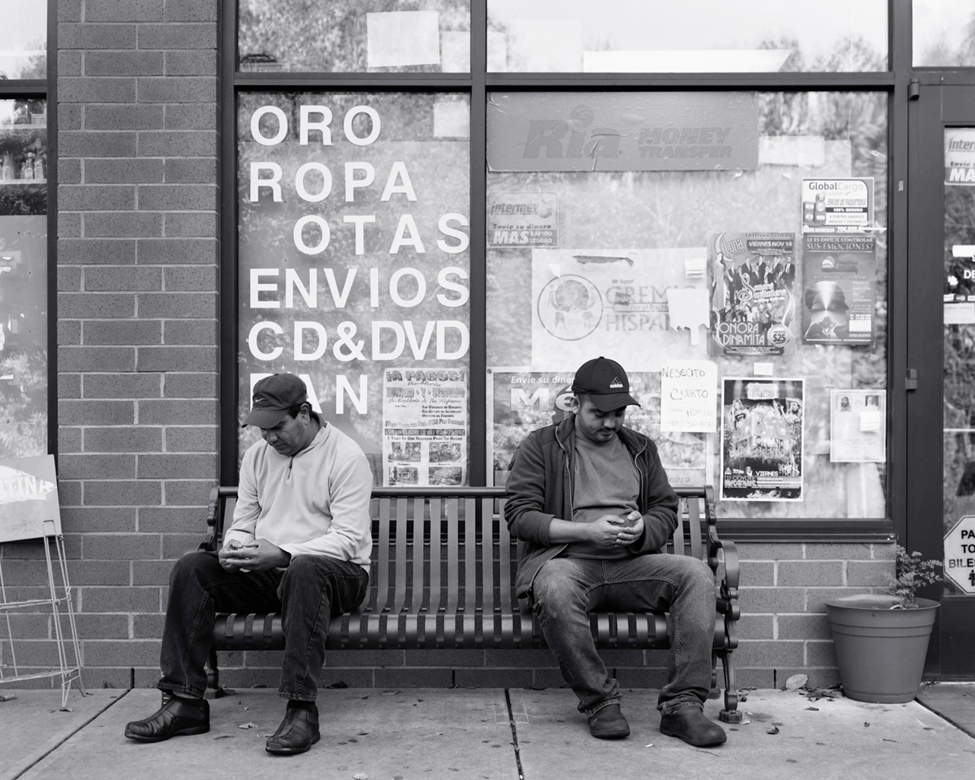
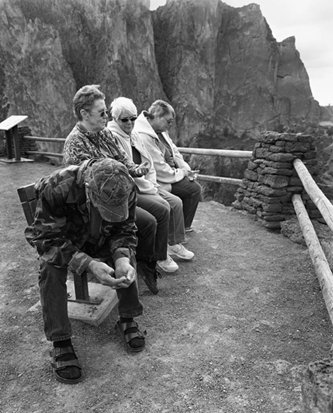
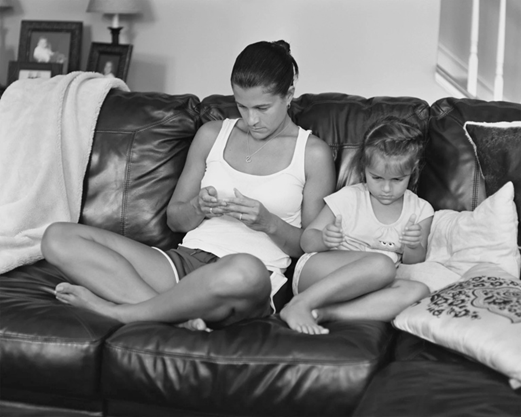
The photographer Eric Pickersgill shown above, shot pictures around the world and removed people’s devices. We’re left with people looking down at their hands and partners looking away from each other.
These photos demonstrate that if we’re constantly looking down, we might be missing a lot more than our partners bids to connect to us.
Brené Brown shares the power of awe and wonder: a feeling and state “essential to the human experience” in which “we can feel overwhelmed by the vastness in something that is almost incomprehensible – it almost feels like what we’re witnessing can’t be true – like we’re seeing something that doesn’t fit with how we move through and understand our everyday lives” (Brown, 2021). We’ve all experienced these moments that seem to go by too quickly.
After an intense day at work, I like to wash the day off me with a hot bath. I notice how my mind and body become quiet and still. Sometimes during these still moments my daughters will disrupt the experience and come galloping into my safe space, but on occasion, the stillness endures and when I’m lucky, translates to a feeling of awe. I notice how deeply connected I feel to them, how small, innocent and lovable they are, and how passionately they speak about ordinary objects. An incredible feeling that stems from my relationships and a moment of clarity that precedes stillness.
Turning away from our devices and towards our loved ones is an act of courage. Our devices alleviate discomfort and offer immediate relief, effortlessly giving us what we think we need. Often, we don’t even notice our hand reaching for them. The gesture has become an automatic reflex of our subconscious being
We turn towards our devices in search of relief when hard thoughts surface, the to do list feels endless, or a conversation leaves an emotional injury. Somewhere along the way, distraction became easier than the risk of connecting. Finding our way back to real connection requires us to tolerate the risks of vulnerability, the tension of a disagreement and the weight of hard feelings. As Waldinger shares, working through these challenges and the messiness of relationships has a profound impact on our wellbeing.
As a working mom and wife, my distractions are endless, especially the ongoing demands of maintaining a home. Many evenings, I feel tired and ready to unwind after a long day. Yet the to do list remains, driving my kids to their activates, cooking, cleaning up the kitchen, putting my kids to bed, finishing work, and trying to spend time with my husband.
It’s as exhausting as it sounds. Seamlessly managing the roles of mother, wife, business owner and therapist simply doesn’t exist. I’m often left with a choice – do I finish my housework, or do I spend time with my family?
I’ve tried to manage it all, to have it all, believing that doing everything would bring me peace. Unfortunately, doing it all doesn’t seem to work. I’ve learned that I can’t have it all, all the time, and that’s okay.
This is where courage is required. The courage to feel at peace when the dishes aren’t done because I chose time with my husband. The courage to calmly read to my children while the laundry waits. It takes courage to prioritize presence over productivity.
If this feels familiar, I invite you to practice mindfulness in your daily life. Slow down and notice the beautiful moments of awe. This recognition will incite more presence and connection.
Leave the dishes, put your phones aside, and look at your loved ones in the eye. Linger in conversation and notice the quiet intimacy of everyday moments. We live in these small, easily overlooked spaces.
When the mess of life triggers guilt or self-criticism, remind yourself that you made an intentional investment into your future. This choice matters.
Additionally, two small, but effective tools to work on enhancing your relationships are to practice turning towards others (instead of your devices) and to make bids to connect to people. Initiate conversations, embrace the mess, plan outings, and support your loved ones. Short term discomfort can lead to a life full of relationships that offer long-term physical and emotional health, wellbeing, and meaning.

Neelam is a Registered Clinical Counsellor, wife to her partner of 20 years, and mother to two young daughters. She founded Life Wise Counselling in Burnaby, BC to support individuals and couples who are seeking meaningful change. Her work is informed by both her individualistic and collective cultural values, with a primary focus on trauma and relationships. Her interests include fitness, yoga, design, and comedy.
Neelam believes that laughter, connection, openness, dreaming, and even the occasional pity party all have a place in healing and personal growth. Currently she has room for a small number of new clients.
Thank you, Neelam, for writing on a critically important topic: the power of human connection. Today, we live in a culture that keeps us so busy and stressed that we have little time and energy left to devote to connecting and spending time with others. Being happy and sharing one’s happiness with others is not considered an achievement in our society. And now, as you point out, Neelam, instead of turning towards each other, when we feel distressed, lonely, etc., we turn toward our devices. However, the need for human connection can never go away: for, that’s what we are made of. So thank you for reminding us of this truth about our selves. I enjoyed reading your guest Field Note!
Hi Heesoon. Thank you for your thoughtful comment! As a therapist, I feel very fortunate to sit with others and engage in deep, vulnerable conversations that are completely phone free. There is something powerful about being fully present with another person. I believe many of my clients feel the quiet magic of setting aside their distractions and sitting in the presence of another person who is dedicated to hearing and seeing them. With the uprising of AI, I found the topic of human connection especially fitting in today’s climate.